RSS FeedFacebookTwitter
Click here for an RSS Feed of Printed Electronics World
Become a fan of Printed Electronics World on Facebook
Follow Printed Electronics World on Twitter
 
Poor Adoption of ITO Replacements - Why?
9 July 2007
Country:

Poor Adoption of ITO Replacements - Why?

 
Forward to friend
×
We welcome your response to this Printed Electronics World Article. Edited responses may be posted in our regular response column. Responses can be anonymous, otherwise, please leave your name and email address.
Name
Email
Response
 
 
Indium tin oxide is used for transparent electrodes in OLEDs, photodetectors, electroluminescent displays, electrophoretic displays, light emitting transistors and other purposes. Indeed, Indium is even more generally used in printed and thin film electronics, the CIGS photovoltaics being widely commercialised in 2007 being a particularly large potential user of indium.
 
The indium price is volatile but the general trend is from $60 per kilogram three years ago to $1000 today. Most believe that $10,000 per kilogram will be reached in due course and that will make the material an expired resource for most practical purposes. Armin Reller of University of Augsberg Germany calculates that the date is only 5-10 years from now.
 
There is more. ITO is typically applied by expensive vacuum sputtering and it is brittle. It even damages OLEDs by migrating with oxygen into the delicate semiconductors. The good news is that there has been a flood of proposed alternatives in the last year. The bad news is that very little ITO has been replaced. Some of the proposals are shown below.
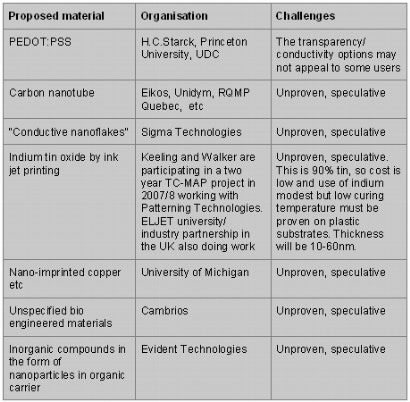
 
Source: IDTechEx
 
Furthest progressed is use of PEDOT. The pan European OLLA OLED lighting project has successfully used the material to replace ITO in experimental white OLEDs on rigid substrates as has
×Princeton University
Princeton University
is presenting at
Energy Harvesting & Storage Europe 2010
Munich, Germany
26 - 27 May 2010
Princeton University with an OLED display. However, market penetration is minimal as yet. Meanwhile, several organisations say they can print ITO to get over the problems of sputtering. Violins on the Titanic?
 
For more attend the following conferences which will have sections on the vital topic of replacement of rare materials:
 
 
Forward to friend
 
×
We welcome your response to this Printed Electronics World Article. Edited responses may be posted in our regular response column. Responses can be anonymous, otherwise, please leave your name and email address.
Name
Email
Response


Dr Peter Harrop
Article by Dr Peter Harrop
 
Dr Peter Harrop is the Founder and Chairman of IDTechEx.
 
Telephone: +44 (0)1256 862163
Email:
 

To learn More:

Attend:

  • Printed Electronics & Photovoltaics Europe 2010
  • Printed Electronics & Photovoltaics USA 2010
  • Read the latest research:

  • Printed, Organic & Flexible Electronics Forecasts, Players & Opportunities 2009-2029
  • Displays and Lighting: OLED, e-paper, electroluminescent and beyond
  • Printed and Thin Film Transistors and Memory 2009-2029
  • Inorganic and Composite Printed Electronics 2009-2019
  • Thin Film Photovoltaics and Batteries 2009-2029
  • Other Recent Articles

  • Organic & Printed Electronics Forecasts, Players & Opportunities
  • Epson and E Ink announce a new addition to the EPD controller family
  • Highlights from the 2010 Flexible Electronics and Displays Conference
  • Read more articles on these topics

  • Applications & Markets
  • Logic & Memory
  • Power
  • Sensors, Sound & Other Components
  • Displays & Lighting
  • Materials
  • Manufacturing
  • Displays & Lighting » OLED
  • Applications & Markets » Displays
  • Copyright © 1999-2010 IDTechEx