

Prime View international (PVI), a Taiwanese manufacturer of TFT-LCDs has been the leader in the manufacture of rigid e-book readers. The competition is currently heating up with the development of Gen II (flexible) e-book readers actively pursued by several companies. PVI believes that they will benefit from their experience with rigid e-Books, but who will win the race remains to be seen.
A brief history of Gen I e-book readers
Glass e-Books were co-developed by Philips, Sony and E-Ink in 2003. The SONY e-book reader launched at the time wasn't particularly successful due to limited content and distribution. In 2005, Philips licensed manufacturing of glass e-books to PVI. Since then, PVI's electronic paper display has been used in 7 e-book readers that are currently commercially available. Recently the e-book business has taken off as plentiful content and easy distribution have become available. For instance, in America the Amazon Kindle has access to 88,000+ titles which can be downloaded via mobile phone networks (typically, in less than 60 seconds per book).
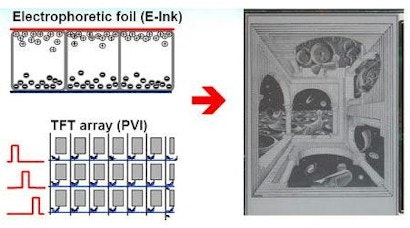
PVI's high resolution monochrome display with 16 greyscales
Development of Gen II e-book readers- EPLaR
Being thinner, flexible and more robust, Gen II e-book readers are currently being developed and will be replacing their heavier, rigid predecessors.
E-ink has made demonstrators with 8 different partners but mass manufacturing is not so easy.
The EPLaR (Electronics on Plastic by Laser Release) process was developed by Philips in the EU FlexiDis programme from 2005 to 2007, most notably with Thales-LCD. EPLaR was subsequently licensed to PVI in May 2007. Using their experience in manufacturing electrophoretic displays on glass, PVI are using the EPLaR process to develop their flexible electronic paper. 95% of the process is identical to the glass electronic paper manufacture and this facilitates the transition from rigid to flexible mass production. The use of well-established a-Si TFTs minimizes the need for acquiring new equipment and so, product release is predicted by PVI for 2009.
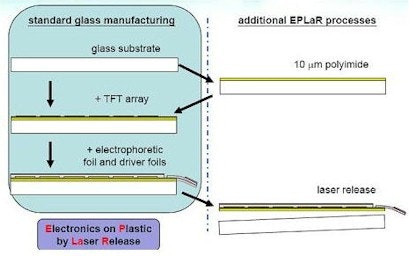
The EPLaR process
The company also has activities on developing wearable displays, secondary displays for laptops and mobile phones as well as electronic shelf labels and smart cards.
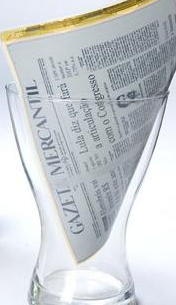
PVI ELaR 9.7" e-paper display
Future generations of e-book readers
The competition in Gen II e-book readers includes among others, the Readius by Polymer Vision and Plastic Logic's e-book reader, both utilizing organic thin film transistors. Efforts to develop colour versions of e-book readers are also underway, with Fujitsu's FLEPia being one example that is still quite pricey as it's only available as a demonstrator for companies that are looking to get involved in the development of colour versions of e-books. The company's bendable color electronic paper comes in two sizes, A4 (480 grams) and A5 (320 grams) and both are just 12mm thick.
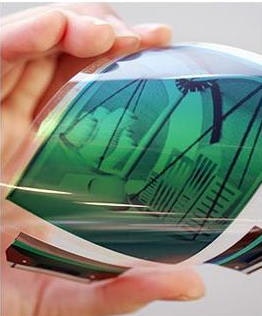
Fujitsu's bendable colour electronic paper

