

Challenges with flexible LCDs
At S.I.D. 2009, Ian French from Prime View International (PVI) gave an excellent presentation on progress with flexible displays. French firstly covered work on flexible LCDs, which IDTechEx recently wrote about after our visit to Hong Kong.
French said that companies that have demonstrated flexible LCDs include Samsung, Toshiba, Kent Displays and Sharp, but none of these have moved into mass production or are even planning mass production.
He stated the reasons for this is that high transparency, colourless substrates are needed with zero birefringence. This rules out steel and most polyimide substrates. PET, PEN and PES are viable in this regard but require low temperature processing - below 200 Degrees Celsius. This makes active matrix backplanes difficult to make, because a-Si is normally processed at 350 Degrees Celsius.
While lower temperature TFTs can be produced, their reliability in mass production is unproven. There are also mechanical issues, where current LCDs rely on the rigidity of glass, which mean that the existing LCD infrastructure could not be used to make flexible LCDs. Flexible LCDs were targeted for cellphone displays because they would be more robust and thinner, but as LCDs on glass became much thinner it negated the demand. According to French, the lack of demand and technical issues mean that flexible LCDs have not been commercialised.
E-readers
Glass e-readers have been available since 2002, first launched by Sony. PVI began mass production of e-reader modules in 2005. PVI only sells the display modules, making the a-Si backplane and laminating an E-ink foil on top and then connecting the silicon chip controllers. It sells these to companies making e-book readers, of which there are now 20 on the market. The most successful has been the Amazon Kindle reader.
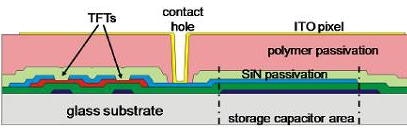
According to several sources, the cost of the 6" display module in the Kindle is $60, versus $7 for a 6" LCD display. Of all the e-readers on the market, PVI supply the display modules to approximately 90% of them. French described that unlike an LCD display, which is driven at +/-6 volts, e-paper is driven at a higher voltage, usually +/-15 volts. PVI therefore puts two transistors in series for each pixel rather than one as you would have with an LCD display to reduce the leakage current, as shown below.
Cross section of an e-paper display module
Source: PVI
Progress on flexible E-readers
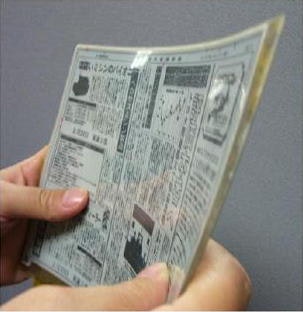
We have covered in Printed Electronics World how PolymerVision and Plastic Logic are bringing e-readers to market that are based on flexible substrates. This is something PVI will also do, but rather than use organic semiconductors, it will continue to use a-Si. PVI are using a process called "EPLaR", standing for Electronics on Plastic by Laser Release. It uses 95% of the same process steps and equipment as that for making glass versions. Here a 10 micron polyimide substrate is securely mounted onto a standard glass substrate. Provided that the correct interface treatments are used in conjunction with the correct type of polyimide and curing schedule, then the polyimide adheres very strongly to the glass substrate and it can withstand all of the standard temperatures and processes used for making TFTs on glass substrates.
In particular, the TFT deposition temperature is not changed, so the TFTs have the same electrical characteristics and stability as standard a-Si TFTs on glass. The a-Si backplane can be made the same way as before and the E-paper laminated on top. Finally, the polyimide substrate is released from the glass substrate by using a laser.
French reports, "A major advantage of the EPLaR process is that the polyimide layer has no measurable effect on the dimensions of the composite substrate because it is so thin and well anchored to the glass substrate. This means that the design rules for EPLaR displays are exactly the same as design rules for TFT arrays on glass and we can make displays with the same high performance and high resolution as glass displays. In comparison, flexible displays made on relatively thick pre-formed plastic substrates must allow for shrinkage on heating and swelling when absorbing moisture. This means that they are not so well-suited to high resolution displays."
Photograph of a 9.7" EPLaR display
Source: PVI
So far, PVI is making these on Gen 2.5 substrates (370x470mm), giving four 9.7" displays (larger displays can be made, but fewer per substrate increasing the cost of each). PVI has recently acquired another display company, which would give it Gen 3 capability - or 15" displays.
The company expects to launch these displays at the end of 2009.
Source top image: PVI
To learn more attend Printed Electronics Asia 2009 or Printed Electronics USA 2009.
