

The New University of Lisbon presented a new Ion Jelly® material, which combines a biodegradable polymer (gelatin) with an ionic liquid (IL). The combination results in a polymeric conducting material (PCM) that appears as a very attractive solution for the development of electrolytic devices, such as batteries, fuel cells, electrochromic windows and photovoltaic cells.
To obtain the Ion Jelly the researchers made use of the ability of ionic liquids to dissolve gelatin, a substance already used in printed electrophoretic displays. The formation of an ion jelly should occur in much the same way as the formation of a water-based gelatin gel.
However, ILs cannot entirely replace water, which needs to be added to stabilize the very hydrophilic gelatin molecules. Once the jellification starts the ionic character of both materials, ILs and gelatin, leads to a strong interaction between them and the high solubility of gelatin.
During the renaturing or annealing process, the polypeptide strands will have a tendency to rearrange into the most thermodynamically favourable structure.
The combination of gelatin and ILs allows the synthesis of extremely versatile electro-conductive materials that can be molded into different shapes, using several techniques, and can be adapted to multiple surfaces.
An important characteristic of Ion Jelly® materials is that not only can they be used as electrolytes, but they can also be formulated to function as electrodes, which is an unusual feature of biopolymers. In fact, this material has the potential to fill a gap between electrolyte solutions and existing rubbery ionic liquid/nanotube/polymer composites, and to have applications in flexible devices and in disposable sensors with low environmental impact.
a) 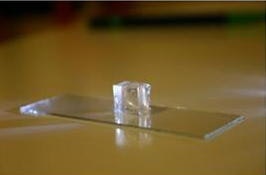
b) 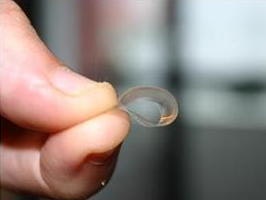
Figure 1: Ion Jelly®. (a) Solid transparent block of [bmim] [(CN)2N]. (b) Solid transparent film of [emim] [EtSO4].
In order to be suitable for utilization in an electrochemical device an electrolyte most importantly must show conductivity above 10-4 S cm-1 and a large electrochemical window above 1 V. Room-temperature ILs fit these requirements, with conductivities within 10-4 to 8 x 10⁻² S cm-1, and electrochemical windows of 4-5.7 V. Additionally, their chemical and thermal stability make them an environmentally friendly alternative to conventional organic solvents.
Existing IL-organic polymer materials are already a replacement for traditional electrolytes in some applications. However, there is still need for improvement, especially regarding processing techniques, which are mostly complex and cost intensive.
These issues can potentially be solved with the new and very simple way to produce Ion Jelly® using gelatin, a widely available and inexpensive gelling agent that can be easily modified by functionalization using chemical or biological agents. ILs themselves can be custom made.
After the jellification process, the resulting material combines the mechanical flexibility of a polymer and the characteristic conductivity of ionic liquids, with the IL used strongly affecting the conductivity. For Ion Jelly films incorporating different ILs conductivity values of the order of 10-5 to 10-4 S cm-1 were shown, which prove to be approximately two orders of magnitude lower than those of the ILs used. This is due to lower ion mobility in the films than in the ionic liquids. Additionally, it was found that these materials exhibit mixed electronic and ionic conductivity.

Figure 2: Ion jelly smart window. Glass-ITO/PEDOT/ion jellx/PB/ITO-glass. (a) Colored state (b) bleached state.
To prove the concept the researchers built an electrochromic window based on Prussian blue (PB), PEDOT and Ion Jelly. Although, this type usually works with a highly concentrated electrolyte solution, it already performed reasonably well in terms of contrast and stability.
To learn more attend Printed Electronics Asia 2009 or Printed Electronics USA 2009.
