

The surge in silver prices is placing increasing pressure on conductive ink manufacturers to develop alternative solutions for printed electronic applications, either with different conductive elements or lower silver content. This article details the technical challenges involved in developing a new ink formulation.
The surging price of silver often dominates discussions around the conductive inks market. As the dominant conductive material in printed electronics, silver represents a significant proportion of formulation costs, driving research into alternatives such as copper, carbon, graphene, carbon nanotubes, conductive polymers, hybrid materials and novel low-silver formulations. However, raw material price is only one part of the equation and to replace silver successfully, an alternative ink must deliver not only comparable conductivity but also consistent manufacturing performance and long-term reliability.
IDTechEx have released a new report, "Conductive Inks Market 2026-2036: Technologies, Applications, Players", providing an independent, third-party assessment of this platform technology. The response to the volatile silver market is covered in detail, with primary interviews of players at all stages of the supply chain included. Displacing silver inks will not be straightforward, and new formulations must overcome several technical challenges to achieve success. Achieving success in one or more fields will not be enough; conductive ink suppliers must provide solutions that simultaneously meet the requirements for particle stability, rheology, printability, processing, adhesion, and overall cost-performance balance.
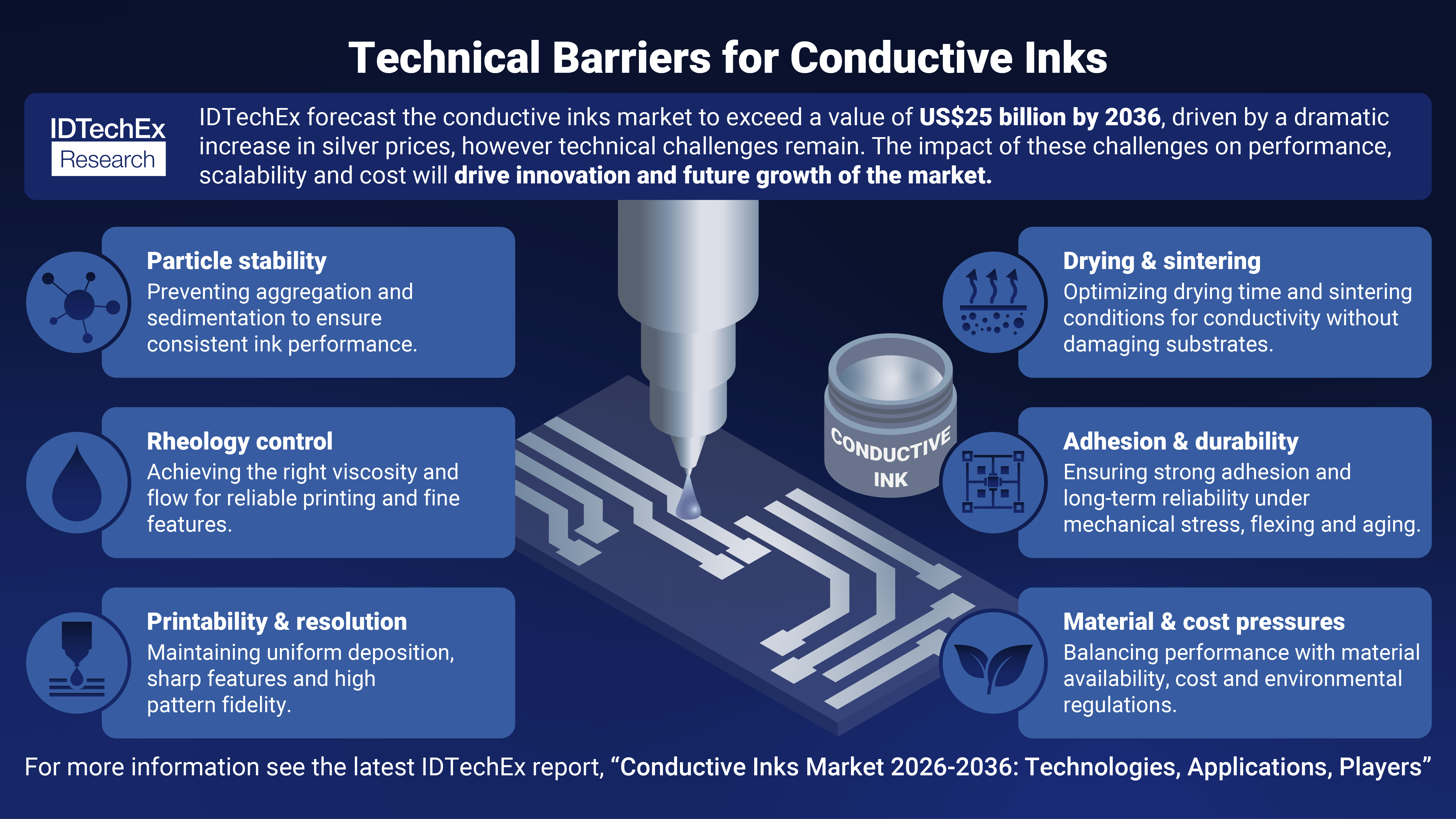
The Technical Challenges Limiting Conductive Ink Development Beyond Silver. Source: IDTechEx
Optimization of Formulation and Deposition Methods
Conductive inks are carefully engineered dispersions of conductive particles within solvent systems. Maintaining stable particle distribution during storage and use is essential for consistent printing. Silver flakes and nanoparticles have undergone decades of optimization, offering excellent shelf life and minimal sedimentation. IDTechEx provides insight into the challenges facing alternative materials. For example, copper readily oxidizes, while carbon nanomaterials like graphene and CNTs tend to agglomerate, which in turn affects viscosity, print quality and conductivity. Without stable formulations, manufacturers face inconsistent production, reduced yields and shorter product lifetimes.
Every printing process requires precise viscosity and flow behavior. Whether using screen, inkjet, gravure or flexographic printing, the ink must deposit consistently while maintaining fine feature definition. Silver formulations have been refined for almost every printing technology. Alternative materials often require different particle sizes, shapes and concentrations, making rheological control significantly more complex. Materials such as graphene and carbon nanotubes can dramatically alter flow characteristics due to a different morphology, requiring sophisticated formulation strategies.
The Printing Process Can Vary by Ink Type
Applications including wearable sensors, RFID antennas and flexible displays demand increasingly fine conductive features. Printability depends on several material properties including particle size, surface tension, wetting behavior and drying characteristics. Silver nanoparticles enable high-resolution printing while maintaining excellent electrical performance. Many alternative materials struggle to achieve the same combination of fine feature definition and conductivity, limiting their suitability for advanced printed electronics.
After printing, conductive inks must be dried and often sintered to create electrically conductive pathways. Silver inks can typically be processed at relatively low temperatures compatible with flexible substrates. Copper requires more stringent process control because oxidation during sintering reduces conductivity, while other materials require specialized curing conditions that increase manufacturing complexity. An extra consideration is that alternative materials must integrate into existing production lines without compromising throughput or substrate compatibility in order to achieve widespread adoption.
Lifetime Durability and Costs Must be Matched
Conductive traces must maintain performance throughout years of exposure to humidity, temperature cycling, and repeated mechanical flexing. Silver inks have demonstrated reliable long-term performance across demanding applications. Alternatives must provide equally strong adhesion while resisting cracking, delamination and corrosion. IDTechEx has tracked the conductive inks market for almost two decades, providing independent insights into product launches and commercial readiness of various ink types.
Although reducing silver content lowers raw material costs, total manufacturing economics are more complicated. Copper may be less expensive than silver, but additional processing can offset these savings. Novel nanomaterials may also remain costly to manufacture consistently at commercial scale. Manufacturers ultimately evaluate total cost of ownership, including production yields, reliability, processing efficiency, and supply chain security, while research is ongoing into recovery of silver from printed electronics at end-of-life to reduce the total lifetime cost of these printed products.
An Outlook for Replacing Silver Ink
The greatest challenge is that these requirements are closely linked and changing one property often directly influences another. For example, improving conductivity may increase viscosity, while stronger binders may improve durability while reducing print resolution. This explains why silver continues to dominate printed electronics despite the elevated cost. Decades of development have produced formulations that balance conductivity, printability, processing, durability and manufacturing consistency.
For alternative conductive inks to achieve widespread adoption, they must match this overall performance rather than outperform silver in a single characteristic. The future of conductive inks will therefore be determined not simply by finding a cheaper conductive material, but by developing formulations capable of satisfying all technical challenges simultaneously. For more insights into the conductive inks market, see the IDTechEx report "Conductive Inks Market 2026-2036: Technologies, Applications, Players".
For more information on this report, including downloadable sample pages, please visit www.IDTechEx.com/Inks, or for the full portfolio of research available from IDTechEx, see www.IDTechEx.com.
